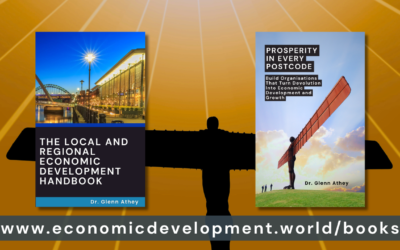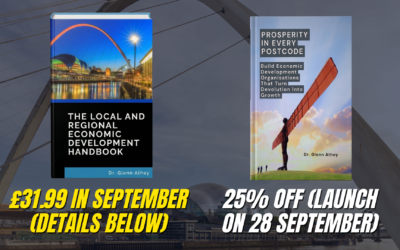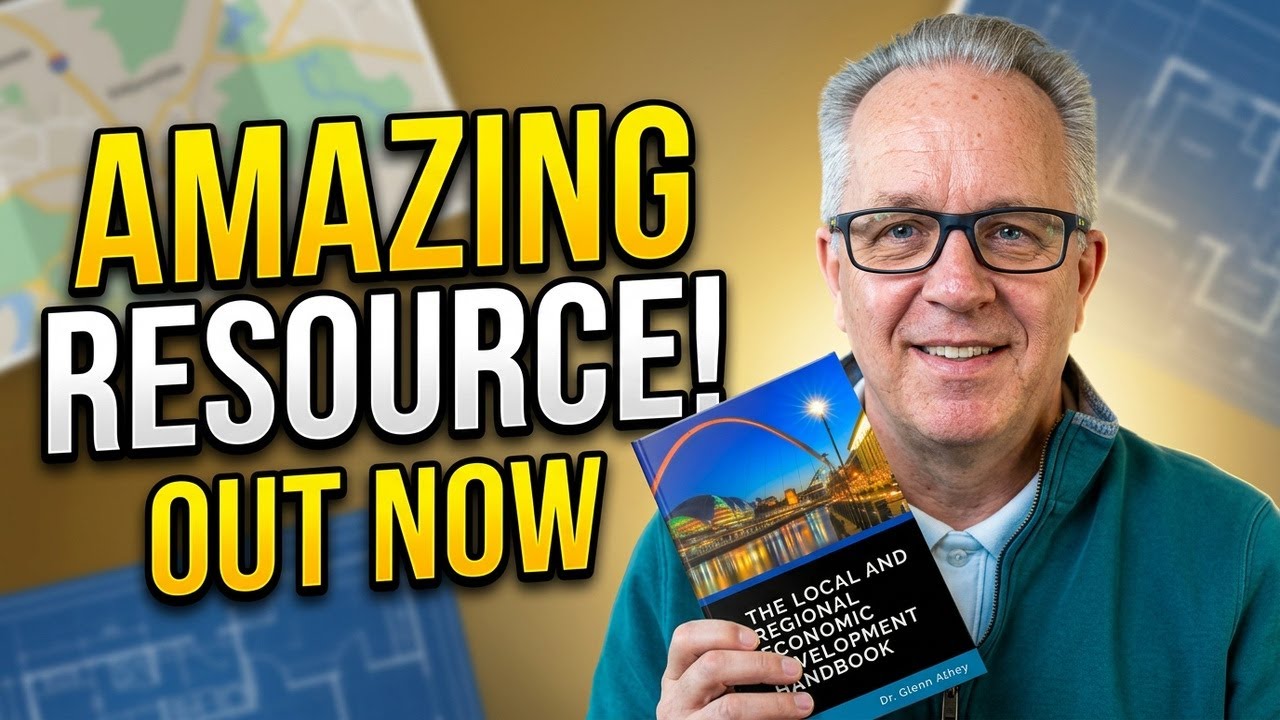

Today’s the day. The Local and Regional Economic Development Handbook is now available in hardback via amazon. After two years of writing — and thirty-two years of practice behind it — the book is out!
I’ve also recorded a ten-minute video walkthrough that takes you inside the covers, chapter by chapter, with examples of the case studies and content. If you’d rather watch than read, the link is below. There’s a stack of information, testimonials from experts who have read and advanced copy, and details about how to get bonus content and video lessons once you’ve bought the book at www.lredhandbook.com.
▶ Watch the ten-minute walkthrough on YouTube
See what the experts have written about my book. Many thanks to Adam Breeze, Professor Pete Tyler, Sami Mahroum (PhD), Duncan Maclennan, Ben Gardiner, Sarah Murray, Mark Beresford, Gordon Kennedy, Clive Gibbon MIED FRSA, Patrick Watt, Howard Partridge, and John P. Houghton for reviewing and providing some kind words of recommendation!
What I set out to write
I wanted to create the book I wish I’d had at the start of my career — and, frankly, the book I wish I’d had on my desk halfway through it.
The driving question while I was writing was simple: what does someone need to know to do this job well? Not a textbook. Not a policy primer. A genuine handbook — the kind a practitioner can pull off the shelf, find what they need, and put back. Built around the functions practitioners actually deliver, anchored in real cases from the UK and around the world, and written in plain language throughout.
I’ve been fortunate to work across many UK regions and internationally over three decades, and the book is my attempt to bring all of that into one place: the key functions, the underpinning principles, the lessons from practice, and case studies showing what good looks like.
What’s in it
The handbook runs to 546 pages. It draws on academic research, policy and evaluation evidence throughout, but it’s structured the way a practitioner would think — around the functions we’re asked to deliver. There are summary tables in every chapter so you can find what you need at a glance, and case studies running through every concept to bring it to life.
The book has two main parts and a closing synthesis.
Part one — the foundations. Why local and regional economic development matters. The mega-trends shaping the places we work in. The essential economic concepts every practitioner should have at their fingertips. Policy, strategy, and the use of evidence and intelligence for informed decision-making. And a chapter on economic development theories — the toolkit for understanding why a local economy looks the way it does, and what kinds of intervention might actually shift it.
Part two — the practice. Chapter by chapter, the core functions: industrial development and clusters; enterprise and entrepreneurship; inward investment; innovation; education and skills; economic participation, employment and inclusion; place, infrastructure and real estate; and low carbon, climate change and sustainability. Each chapter follows the same pattern — key principles, key concepts, case studies, practical lessons.
The closing synthesis pulls the lessons together into a single summary you can take straight into your own work.
A peek inside the covers
The fastest way to give you a real flavour is to pull a few chapters off the shelf.
Essential economics. Every concept lands on the page with a case study beside it. Opportunity cost is illustrated through Boston’s Rose Kennedy Greenway. The use of incentives to stimulate economic activity is illustrated through Georgia’s tax credit programme to attract film and television production. The principle and the real-world application sit side by side — that’s the pattern throughout the book.
Policy. I walk through the typical policy process, then show how national or regional policy shapes what’s possible at local level. Texas, for instance, has a sales tax precept that allows municipalities to fund economic development directly — and Texan cities have used it to build workspaces and incubators for small businesses. It’s a great illustration of how policy architecture can unlock local action.
Strategy. The chapter sets out the typical strategy process, the stages and choices involved, and the principles that distinguish strategies that deliver from strategies that sit on shelves. Plenty of real cases — what worked, what didn’t, and why.
Intelligence and research. How to commission it, how to do it, and how to make it genuinely useful for local economic decisions.
Economic development theories. I treat these as a working toolkit, not academic curios. The chapter draws on The Rise and Fall of Urban Economies — a brilliant book that uses development theory to explain why San Francisco and Los Angeles, with broadly similar starting positions in the 1950s, ended up on radically different trajectories. It’s a powerful illustration of what theory can do for practitioners who use it well.
The practice chapters are where the book really earns its keep. They take up more than half its pages, and each one is built the same way — principles, key concepts, case studies, practical lessons.
Industrial development and clusters tackles how to read your local economy’s industrial structure, when cluster strategies are worth the effort and when they aren’t, and how to build sector strategies that connect to real local strengths.
Enterprise and entrepreneurship covers the ecosystem practitioners need to grow — from start-up support through to scale-up, with practical guidance on what actually moves the dial and what tends to be activity for activity’s sake.
Inward investment draws on a great deal of UK and international practice to look at proposition, targeting, account management, and the relationship between investment attraction and broader place strategy.
Innovation covers innovation systems, R&D, university–industry links, and the kinds of intervention local and regional bodies can realistically make. It treats innovation as something practitioners can shape, not something that happens to them.
Education and skills addresses the perennial questions: how to build a skills supply that matches local employer needs, how to engage employers in shaping it, and how to make the system work for residents who are currently locked out of it.
Economic participation, employment, unemployment, poverty and inequality is the chapter I expect practitioners to come back to most. It treats inclusion as a core economic development function, not an afterthought, and gives plenty of practical examples of how localities have tackled employability, in-work poverty, and labour market access.
Place, infrastructure and real estate makes the case that successful real estate and infrastructure investment depends on understanding the place economy it lands in — and shows what that looks like in practice through case studies of investment that worked because the place fundamentals were right.
Low carbon, climate change and sustainability takes a delivery-first lens. What does a local low-carbon economy actually look like? How do practitioners deliver it? What case studies are showing the way?
Together these chapters give practitioners the depth they need on the function in front of them today, and a reference for the function they’ll be asked to lead tomorrow.
>>>> BUY THE BOOK ON AMAZON HERE <<<
Who The Local and Regional Economic Development Handbook is for
If you’re new to economic development and you want a serious grounding in the field, this book is for you.
If you’re an experienced practitioner who needs depth on a topic outside your usual specialism, this book is for you.
If you’re a senior leader or elected member working out what economic development can deliver for your community, this book is for you.
If you’re an investor or developer who wants to understand the ecosystem your projects land in, this book is for you.
I’ve worked hard to make it readable for any of those audiences. The structure is functional, the language is direct, and the case studies do a lot of the heavy lifting.
How to use it
Different readers will use the book different ways, and it’s designed for that.
If you’re new to the field, read the foundations end to end. Part one will give you a confident grounding in the rationale, the economic concepts, the policy and strategy disciplines, and the theory toolkit. From there, work through the practice chapters at your own pace.
If you’re an experienced practitioner, you’ll probably go straight to the chapter that maps to whatever’s on your desk this week. The summary tables at the end of each chapter mean you can get the headlines in five minutes and go deeper when you have time.
If you’re a senior leader or board member, the foundations chapters and the closing synthesis will give you a clear picture of what good local and regional economic development looks like — and what to expect from the people delivering it for you.
The book is a working tool. It’s meant to be used, marked up, and returned to.
More than a book — what comes with it
When you buy the book, register your copy at
Where to find it
- The book — available now on Amazon, hardback and paperback. Buy on Amazon →
- The ten-minute video walkthrough — Watch on YouTube →
- Register your copy for bonus content — lredhandbook.com
- Companion platform — economicdevelopment.world — community of practice and ongoing learning resources
I hope you enjoy the book, and I hope it earns a place on your desk
This profession matters, and the people in it deserve a resource that backs them up. That’s what I set out to write. If it’s useful to one practitioner picking it up at the start of their career, or one experienced hand reaching for it on a topic outside their specialism, it will have done its job.