
If you want to keep the momentum of devolution going and don’t want to see powers and resources taken back by Whitehall in 10 years, you will need to be. The UK government has a bad habit – it abolishes the institutions and structures for local economic development and growth on average, every 10 years.
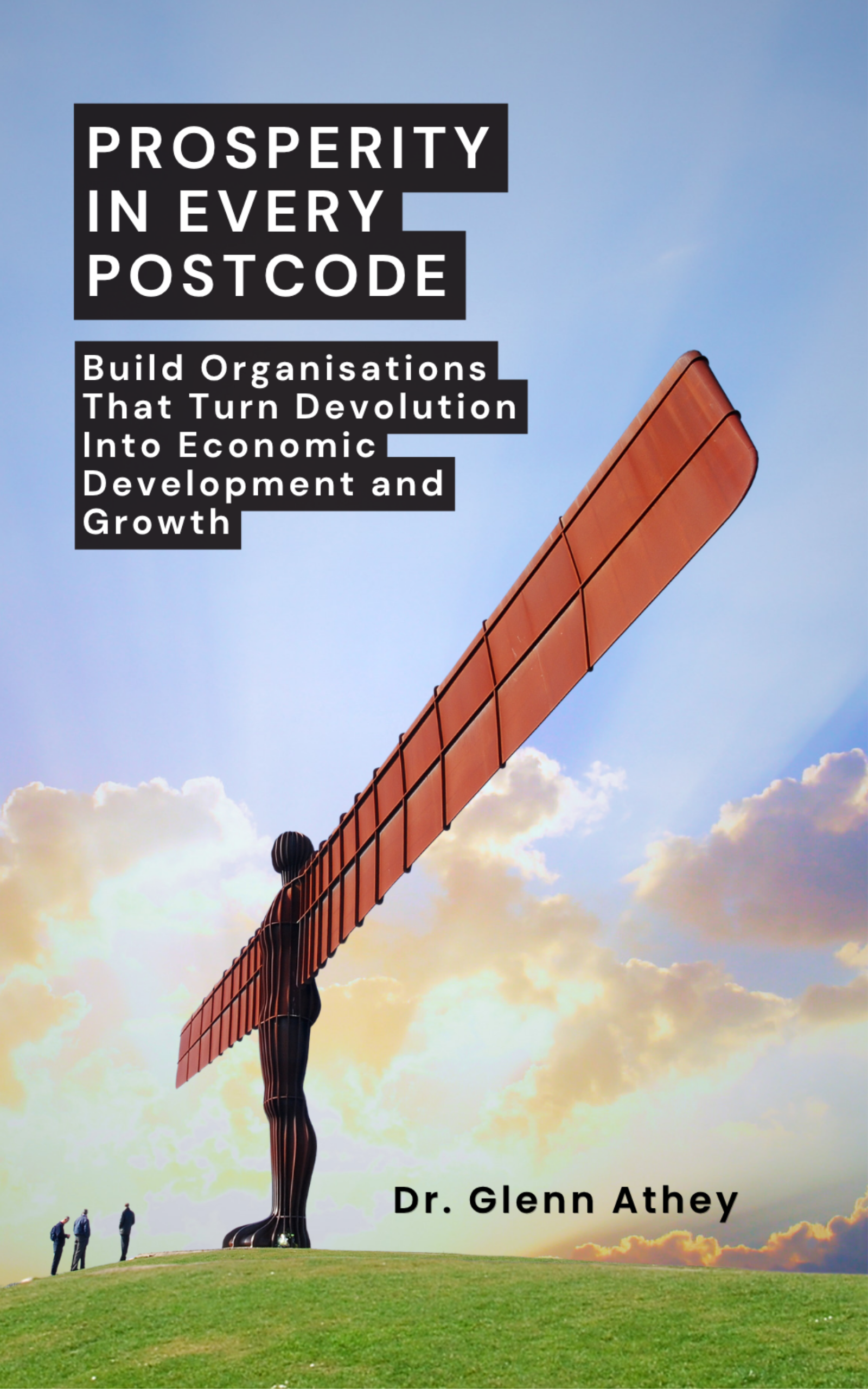
My new book is out today. If you want to learn more or get a copy – go to the site here.
“This excellent book sets out the intellectual arguments and policy mechanisms for securing this goal. It is replete with well-founded policy guidance, based on the author’s many years of practical local development practice.” PROFESSOR RON MARTIN SCD FBA, PROFESSOR OF ECONOMIC GEOGRAPHY, UNIVERSITY OF CAMBRIDGE
Five questions, three first actions and two deadlines from Prosperity in Every Postcode
England’s Regional Development Agencies returned £4.50 to £6.40 for every pound they spent. They were abolished anyway.
I start there because it upsets a comfortable assumption – that good work protects the institution doing it. It doesn’t, not on its own. Delivery has to be visible, and the evidence of it has to exist before anyone asks for it. That is one of the threads running through my new book, Prosperity in Every Postcode, which opens with a single question: do you want to be great at economic development?
The stakes are high. Forty years of spatial policy have left the map of English prosperity looking much as it did in the late 1970s. Across Great Britain, 144 of 350 local authority areas, home to 42% of the population, produce output per head at or below three-quarters of the UK average. The ideas were rarely the problem. Regenerating deprived neighbourhoods, building strategic regional institutions and backing private investment in weak economies were all sound ideas. What failed was the machinery beneath them, and the pattern it produced: over-promise, under-resource, disappoint, reorganise, repeat.
What greatness is
Greatness is not a budget, and it is not a devolution deal. It starts with an honest diagnosis of the local economy and the causes that led it here. It is foresight practised on a schedule, and ambition delivered through a pipeline of projects, initiatives and services. It is the project stopped or changed without sentiment, the delivery problem diagnosed without defensiveness, and the evaluation that changed a decision. It is the partnership that changed a partner, the culture that survives its own reorganisations, and prosperity that reaches the postcode that needed it most.
None of that needs new powers or legislation. It needs a choice.
“Glenn Athey has written the book the new devolved institutions need before they need it. He is unflinching about forty years of central failure, but braver still in holding a mirror up to those of us who lead locally. If you are building a strategic authority or a new unitary council and you want it to deliver, not just announce, read this now.” ROB HUNTINGTON, CHIEF EXECUTIVE, ROSSENDALE BOROUGH COUNCIL
Five questions for your office wall
The book is built around five questions. I would like every economic development leadership team in the country to put them on the office wall, and to ask them of every major commitment.
- What’s the cause – and are you sure you know?
- What’s possible – and why might you be accepting ‘not possible’ for an answer?
- What will you build – and what will you stop doing?
- If delivery isn’t working – why?
- How will you know it worked – and that it benefited who you said it would?
A leadership team that can answer all five, in public, with evidence, is running one of the best economic development functions in the world – whatever its budget. Here is a flavour of what sits behind each one.
“What a brilliant book! It shines an important light on how to actually make economic development work at what is a pivotal time in the industry. Glenn is genuinely curious in examining best practice and barriers to economic development and is generous in sharing his considerable experiences to bring together practical ways to build a best in class economic development team. I wish I had this years ago!” JAMES CUSHING, HEAD OF LOCAL GROWTH, CONNECTED PLACES CATAPULT
What’s the cause?
Data describes. People explain. A descriptive statistic tends to arrive already phrased as a solution. Low skills becomes a training programme. A low start-up rate becomes an enterprise service. Low graduate retention becomes a stay-in-the-city campaign, often before anyone has asked why. The book sets out four questions to ask before designing any intervention, starting with whether the problem is a stock or a flow, and whether the gap comes from the make-up of the local economy or from how its firms perform. Then it asks you to test every causal claim as a sceptic would, beginning with the rival explanation.
What’s possible?
Many British industrial towns and cities discovered that transition was upon them on the day the factory closures were announced. Foresight in good times is cheap. In a crisis it is expensive and late. Glasgow shows the alternative. From the Glasgow Eastern Area Renewal project in 1976 to the Clyde Gateway, it has discovered its future in stages over fifty years. You only find out what is attainable, and where your real capabilities lie, by reaching for an ambition and testing it. That means refusing ‘not possible’ as a first answer.
This process is called discovery. It runs against the British ‘precautionary principle’ of not trying things out because it might fail. Time to abandon the precautionary principle, because you won’t learn anything until you reach for solutions and discover what works, what you can improve, adapt and invent along the way.
What will you build, and what will you stop?
Funding windows reward readiness, not need. In the book I compare two places. Place A held a pipeline of appraised propositions and was contracting within months of its allocation. Place B began deciding what to do on the day its allocation was confirmed. Eighteen months later, construction cost inflation meant its project could not be completed and the grant drawn down in time.
The difference was machinery: a programme management office with appraisal and commercial skills, a permanent pipeline at graduated stages of readiness, and a filter able to stop weak schemes. My LPIP research at the University of Birmingham found business case development to Green Book standard among the most acute skills shortages in the field. An institution that cannot appraise a business case cannot safely buy one.
“As we move to a new phase of devolution in England, this book challenges place leaders to start with an honest and critical view of their local economy’s past, present and potential future. This powerful book jumps straight to the hard truths about local economic development – and gives practitioners the tools to face those hard truths.” MAJEED NEKY, ASSISTANT DIRECTOR, ECONOMY, WEST LONDON ALLIANCE
If delivery isn’t working, why?
Delivery is where reality pushes back. Contractor prices come in high, landowners go quiet, grid connections slip and elections change the priorities. None of that means the project was wrong. One employment site in the book was master-planned around a single anchor occupier who never came. The team asked why, read the market, and reconfigured it into seven smaller plots. Asking why early, and diagnostically, is what turns a stalled programme into a working one.
How will you know it worked?
Devolution has no constitutional protection. When a local fund or institution cannot explain why a programme is underperforming, the political default is to abolish it. Evidence assembled years in advance is what keeps the powers in place. So the book asks for learning to be designed in at approval: a baseline, a theory of change, named indicators and data sources, and an answer to who benefits before the first pound is spent. The test I keep coming back to is simple. Name one decision an evaluation changed.
The answer is inside the building
For my doctorate I carried out ninety interviews in Belfast, Berlin, Glasgow and London. The things reorganisations change – legal status, board composition, the name on the door – did not predict effectiveness. Management quality, staff capability and culture did. Those are exactly the things reorganisations disrupt.
Singapore’s Economic Development Board helped take output per head from around USD 500 to over USD 20,000 in twenty-five years. Edgar Schein traced much of that to a culture built deliberately, with feedback to investors within twenty-four hours, zero tolerance of corruption and mistakes treated as learning. Integrity lowered the risk premium on an entire country.
Partnership works the same way. Greater Manchester’s 2014 devolution deal rested on nearly thirty years of joint working, which began when the ten councils chose to keep collaborating after the county council was abolished in 1986. By the time the deal arrived, the evidence base, the habit of collective decisions and the delivery bodies already existed. Whitehall backed machinery it could see.
“Glenn Athey pulls no punches when he says that, if we want to achieve growth in the places we work to support, then that economic development work and the teams that deliver it needs to be great. Not good or adequate, but GREAT. The book provides the motivation and clear steps to build and lead great economic development work. If you need to be convinced, or to convince others, that great work is both essential and achievable, read Prosperity in Every Postcode now.“ HOWARD PARTRIDGE, FORMER INNOVATION LEAD FOR INNOVATE UK’S STRENGTH IN PLACES FUND
Three things to start this week
Every chapter of the book closes with the one action that returns the most if you start it this week. There are thirteen. Here are three.
- Print your strategy’s intervention list. Cross out everything that could have appeared in a 1996 plan, and take what is left to your next leadership meeting as your real strategy.
- Give your latest performance report to someone in finance or legal with no stake in the programme. Ask them to find the three biggest problems in ten minutes.
- Walk from your most deprived neighbourhood to your flagship investment, and list everything that connects the two – physically, educationally and economically.
“The book offers a non-nonsense guide to the factors that local leaders should consider in their quest to be Top-of-the-Class…. Analytically rigorous and easy to read, this book should be compulsory reading for those charged to take advantage of the opportunities provided by devolution to transform their local economies.” PROFESSOR PETER TYLER, EMERITUS PROFESSOR OF URBAN AND REGIONAL ECONOMICS, DEPARTMENT OF LAND ECONOMY, UNIVERSITY OF CAMBRIDGE AND EMERITUS PROFESSORIAL FELLOW AT ST CATHARINE’S COLLEGE, CAMBRIDGE
Two tests: 2031 and 2036
The devolution agenda faces two tests. The first comes at five years, in 2031, because that is when the political appraisal begins. By then a devolved institution should be able to point to things people can see and feel – jobs that pay better, town centres that work, young people who stay, skills provision employers use – and to the evaluation evidence that proves its own contribution. The political appraisal does not distinguish between an institution that failed and one that had not yet got round to succeeding.
The second comes at ten years, in 2036, and it is a national test. Has measurable convergence towards national or peer-area performance begun? Does the devoluton settlement work visibly enough that no incoming government dares reverse it? Pass, and the prizes start to arrive: the £40 billion productivity gap closing and the ‘begging bowl’ retired. Fail, and powers are withdrawn budget line by budget line, and the places the settlement was meant to serve pay for the failure twice over.
The difference between those futures is not the generosity of the settlement or the sympathy of the Treasury. It is whether the new local and regional institutions can close the gap between the strategies they publish and the outcomes they deliver. That is a question of capability. Capability is buildable. Building it is a choice open to every authority in the country, at every budget, starting now.
Do you want to learn the disciplines that separate places that deliver from places that can only dream?
Prosperity in Every Postcode launch day book deal is now active
For launch day, until midnight on 23 September, it is available at a discount price of £9.49 + postage. Thereafter it goes up to the full retail price £18.99. Go to https://www.economicdevelopment.world/buypiep to purchase, and use the COUPON CODE 44710-PIEPLA09 to access your discounted hard copy.
Prefer an ebook? It will be out in a few weeks. Subscribe at https://www.prosperityineverypostcode.com for launch offers.
#EconomicDevelopment #Devolution #LocalGovernment #CombinedAuthorities #RegionalPolicy